Historical Meaning Behind ‘Equal Protection of the Laws’
by P.A. Madison on February 6th, 2009
Equal Protection of the Laws simply means all persons shall be tried and punished equally before courts of law as it did under Common Law. The clause has no application outside of criminal law which explains why the Fifteenth and Nineteenth Amendments were needed.
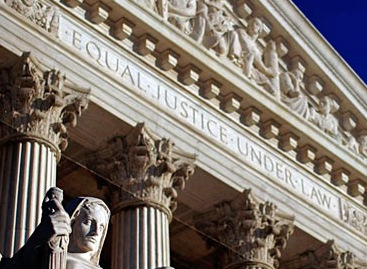
Justice Scalia speaking of the Fourteenth Amendments Equal Protection Clause (EPC) to students at UC Hastings College of the Law in September 2010 remarked, “nobody thought it was directed against sex discrimination.” Scalia could have added nobody thought it was directed at segregation, elections, marriage or local civil law, either.
The phrase “Equal Protection of the Laws” is another way of saying “equal and exact justice” or, “under the protection of law.” Long before the Fourteenth Amendment came into existence the phrase “Equal Protection of the Laws” was used in England as synonymous with “impartial administration of justice.” Bills of Pains and Penalties were objected on the grounds it placed subjects outside of the protection of laws of Due Process in court proceedings.
First thing one must understand from the words of the clause is what it does not say, such as equal rights, equal treatment or equal benefits, etc. The clause speaks only of laws of “protection.”
These laws of “protection” obviously must be the laws of Due Process since these are the only laws of protection of person and property that has been known to law for centuries. This is confirmed by the clauses primary author, Rep. John Bingham of Ohio, explaining how the Magna Charta “gave the protection of the laws only to freemen” while the Fifth Amendment’s Due Process clause used “more comprehensive words, ‘no person'” shall be deprived of life, liberty or property without Due Process of law, and thus, “the people by their Constitution declared the equality of all men, and by the express limitation forbade the Government of the United States from making any discrimination.”
This Equal Protection applied to citizens of a State within the limits of another State (but not their own State) because Due Process was a privilege and immunity of citizenship that followed citizens outside of their State under Section II of Article IV, and hence, already existed as a limitation against State action: “No State ever had the right, under the forms of law or otherwise, to deny to any freeman the equal protection of the laws,” explained Rep. Bingham. The problem at the time of course was not every State considered persons of color born in the United States to be a citizen which in return meant they could deny them the protections of law.
To remove any doubt, Rep. Bingham in his March 31, 1871, Congressional Globe remarks explicitly stated the EPC was only to secure equality in Due Process:
Surely the gentleman (Farnsworth) then supposed the words “equal protection of the laws” were more than a glittering generality; that they were to be enforced to the extent of securing all guarantees of life, liberty, and property as provided by the supreme law of the land, the Constitution of the United States.
A year earlier Rep. Bingham stressed “no State can deny the equal protection, not of its laws, but of the laws,” i.e., laws of Due Process protection.
The EPC was explained in the House of Representatives by Rep. Thaddeus Stevens (Co-Chairman of the Reconstruction Committee) as securing only Due Process in the administration of justice in State courts:
Whatever law punishes a white man for a crime shall punish the black man precisely in the same way and to the same degree. Whatever law protects the white man shall afford “equal” protection to the black man. … Now different degrees of punishment are inflicted, not on the magnitude of the crime, but according to the color of the skin. Now color disqualifies a man from testifying in courts, or being tried in the same way as white men.
Senator Jacob M. Howard explained the EPC in the same terms before the Senate:
It prohibits the hanging of a black man for a crime for which the white man is not to be hanged. It protects the black man in his fundamental rights as a citizen with the same shield which it throws over the white man. Ought not the time to be now passed when one measure of justice is to be meted out to a member of one caste while another and a different measure is meted out to the member of another caste, both castes being alike citizens of the United States, both bound to obey the same laws, to sustain the burdens of the same Government, and both equally responsible to justice and to God for the deeds done in the body?
Apparently the Senate later considered “head taxes” that some states were unequally levying against immigrants depending on their nationality to be a penalty in law requiring the tax to be “equal” among all immigrants. This might have been a real stretch considering it was at war with the legislative debates but appears to be the only questionable assertion of its application by those who were directly responsible for its adoption.
Probably nobody explained the EPC better than Governor Oliver P. Morton of Indiana in July of 1866:
By this it is intended to throw the equal protection of the law around every person who may be within the jurisdiction of any State, whether citizen or alien, and without regard to condition or residence, not only as to life and liberty, but also as to property. It has happened in times past that several of the Southern States discriminated against citizens of other States, by withholding the protection of the laws life and liberty, and denying to them the ordinary remedies in the courts (be a witness, give evidence, enforce contracts, etc.) for the vindication of their civil rights, and hence the adoption of this provision.
It’s no wonder the Court in the 1873 slaughterhouse cases observed the only way for an Equal Protection case to come before the court was by “State oppression, by denial of equal justice in its courts.” History of the words proves the court correct here.
Some argue it would had been absurd for the insertion of two clauses securing the same guarantees of Due Process. This line of argument misses the point of how the two clauses operate: Removing the option of Southern States arguing they are not denying anyone Due Process by unequally applying it to different racial classes. In other words, the Fourteenth Amendment secures Due Process from both outright denial as well as from being unequally administered in State courts to different racial classes.
And finally, it is important to remember the only controversy sought to be addressed by inclusion of the Equal Protection Clause was how former rebel States under the administration of President Andrew Johnson were administering criminal law (black codes) with different degrees of punishments depending on color of the accused along with different trial rules (prohibition of black suspects to give evidence, be a witness, etc.) and not general public law. Blacks were also prohibited from seeking justice in courts to enforce contracts or protect real property ownership.
Mr. Bingham argued again in 1875 against the new Civil Rights Act that the clause could not be used as an instrument to interfere with public laws of the states outside of the courtroom:
I know of no power lodged in the central government to interfere in the domestic affairs of these States or their laws in absence of some positive organic act of a State that places one class of persons at an disadvantageous over another in the protection of life, liberty or property before their courts of justice for an offence made a crime. The fourteenth of amendments most certainly does not confer this power.
He was as absolutely correct then as he is now.
The phrase “Equal protection under the Law” is referring to the Civil Rights Acts, not whether two people of the same gender can marry each other.
Great point about the distinction between “equal protection” and “equal rights.” The clause never commanded a state to provide equal rights in law, only equal justice.
Good article that explains the concept of equal protection very nicely and demonstrates the courts current judicial precedent is horribly wrong and in need of a new factual reevaluation so that written law can once again prevail.
Interesting analysis and perspective.
One small note, I think its “Magna Carta,” translating to “Great Charter” which could refer to its important place oin English law, or to the large size of the parchment on which it was written.
Evidently, the charter itself has changed greatly in scope and importance over the centuries, as one monarch succeeded another.
I think that it is interesting to see the contrast in the view of the role and importance of English law and the common law tradition as the basis for American law between this article and the discussion of “natural-born” citizenship elsewhere on this blog.
Congress was probably aware of this truth and instead had to rely on, cough, the commerce clause to justify their 1964 civil rights act and not the 14th amendment.
Mike said: “I think that it is interesting to see the contrast in the view of the role and importance of English law and the common law tradition as the basis for American law between this article and the discussion of “natural-born” citizenship elsewhere on this blog.”
One problem: Magna Charta had absolutely nothing to do with allegiance to the crown. I know this disappoints you because you wish so much to prove every person born in the USA to be instantly a natural subject, owing perpetual allegiance to the POTUS just like it was once under common law to the king.
Makes sense to me for no other reason the language speaks only of the “protection” of the laws. It had always been the unquestioned purpose of the laws of due process to “protect” people from arbitrary actions of judges. How the clause became morphed into guaranteeing “all laws” should apply to EVERYONE is very puzzling.
All the chatter about “all persons” having the right to “equal protection” of the laws is a SCAM, a fraud. The Supreme Court ony jas consistent;ly ruled that equal protection for persons in a “suspect classificationin”l sudchas ra ce, sex being the major contributors. Laws that discriminate against the public in general and no singling out members of suspect classification the ordinary cititizen can be denied equal protection if they are not specially singtled out for reasons of race aNnd/or sex.
we all can read and understand that the words, “no persoin shall be denied equal protection of the law Apparently the courts are too busy to permit the regular and ordinary persons having the right to equal protection. The Constitution is supposed to be read using the words of the Constitution, yet the courts universally describe the 14th Amendment as applying tlo newly freed “colored people”.
The constitution also does not guarantee that federal judges be appointed for life. The constitution states that the apponted judges shall”serve during good behavior”. I say Scalia, Roberts andf Alito should be impeached and reemoved from the Court.
I never realized congress had defined the meaning of the equal protection clause to proceedings of law. Thanks for pointing that out!
If the commerce clause can be used to justify regulation within states, it can also be used to justify regulation within foreign nations.
i am reserching for we the people and this has to do with my question it helped a lot thanks for posting
Good point about the 15th amendment there, and I think it pretty much proves the equal protection of the laws means laws of due process since “protection” is the purpose of due process. I think Bingham should had used “under the protection of law” instead.
I’m guess I’m not surprised to find that differing opinions are unwelcome. Forgive me, I thought substantive debate had intrinsic value….
Just to note the court does in fact acknowledges a federal equal protection clause under the 5A. Why they think equal protection under the 14A operates differently is surprising since they are both based on the same clause and speak of the same protection.